CBRN: Europe facing the resilience challenge
Long associated with the most extreme scenarios, the nuclear, radiological, biological, and chemical (CBRN) threat is now returning to the European strategic debate. The war in Ukraine, the deterioration of the international environment, the circumvention of norms, and the rise of hybrid threats remind us that CBRN can no longer be regarded as a strictly technical subject. It now belongs to a broader reflection: operational adaptation, the resilience of societies, and Europe's capacity to anticipate complex crises—extending even to questions of industrial sovereignty.
By Ludovic Ouvry, CEO of Ouvry SAS

A risk set within a new strategic environment
The use of chlorine by Bashar al-Assad's regime against his own population brought the CBRN risk back into the spotlight. Certain red lines can be circumvented or crossed, even within a framework where international conventions formally remain in force. Today, several states or actors seek not so much to break openly with norms as to maneuver in a grey zone. The war between Ukraine and Russia has reminded us of these forgotten weapons: the threat of tactical nuclear weapon use brandished by Putin, the use of incapacitating gas on the battlefield, the targeting of chemical plants, and the risk of collateral destruction at the Chernobyl and Zaporizhzhia nuclear sites.
But that is not all. The hybridization of threats further complicates matters. A CBRN crisis will probably not occur in isolation. It could form part of a broader sequence, combining conventional action, cyberattacks, disinformation, pressure on critical infrastructure, or reputational maneuvers. This is why CBRN preparedness cannot be limited to a simple equipment-acquisition approach. It rests on building a comprehensive capability that presupposes a doctrine, an organization, procedures, an industry, and a shared crisis culture.
Adapting systems to new theaters of operation
Contemporary theaters of operation are redefining the requirements of CBRN protection. The widespread use of drones, permanent surveillance, artificial intelligence, and electronic warfare compel us to rethink not only modes of action but the systems themselves.
Ensuring the protection of the soldier in contested spaces now requires low-signature equipment that can be donned quickly and is compatible with weapons systems and related gear. It can no longer be conceived as a fixed system: it must be modular, adaptable to the threat level, and designed so as not to degrade the wearer's operational capabilities.
Whatever the context, the level of CBRN protection must remain proportionate to the assessed threat—without ever becoming a limiting factor for accomplishing the mission.
Innovation closer to the operational need
Innovation remains essential. But it must be conceived as close as possible to the field. In our defense and security domains, an innovation cycle that is too long can produce equipment already obsolete by the time it reaches maturity. The lessons from Ukraine show this: needs evolve quickly, uses transform, and adversaries adapt. The challenge, therefore, is not only to aim for the most advanced technology, but to develop solutions that can be integrated rapidly, capable of meeting a concrete need and improving through iteration. This requires accepting a more pragmatic approach to innovation. High technology is indispensable, but it must remain in the service of operational effectiveness. Protection, detection, and decontamination cannot be conceived apart from the realities of the field.
Sovereignty and simplification: the watchwords
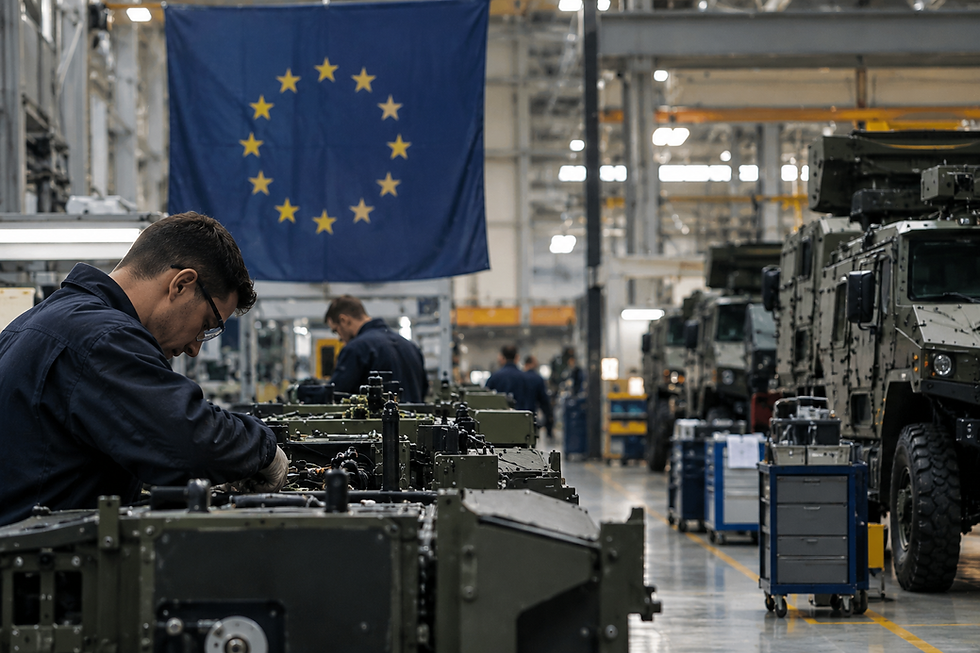
In our defense and security industry, sovereignty is not reducible to the location of a factory or the final assembly of a product. It implies command of design, critical skills, engineering offices, supply chains, and essential components. In the CBRN domain, this command is decisive. Major crises always create tensions in supply. It is therefore not enough to produce in Europe; one must understand and secure the entire industrial chain.
The objective must be a sovereignty that is at least European. This requires strengthening existing industrial actors, supporting SMEs and mid-cap companies, and preserving the skills that make it possible to design, manufacture, adapt, and maintain equipment over time.
A European preference in defense and security procurement would, in this respect, be an important lever. It would help consolidate an internal market that is still too open to competitors who often benefit, in their own countries, from more structuring support. It should be accompanied by a European Small Business Act, in order to better channel certain tenders toward SMEs and mid-cap companies, whose responsiveness is a major asset.
The regulatory question is another key point. Europe will not be able to strengthen its defense industrial base if it does not address the issue of timelines, standards, and procedures. Building a factory, recruiting, certifying, expanding production capacity, or adapting an industrial chain cannot take years when the strategic environment demands greater speed. In sectors considered strategic, accelerated, harmonized procedures adapted to priority projects should be able to be put in place.
Preparing societies with measure
Finally, resilience cannot be solely military or industrial. It also concerns societies. On CBRN, the exercise is delicate: one must inform without causing undue alarm, prepare without dramatizing, and train without disseminating knowledge that could be misused.
This balance partly explains the public's limited familiarity with these risks. Yet a better-prepared society is also a society less vulnerable to panic, disinformation, and disorganization. Risk education must therefore advance, with discernment, in conjunction with the authorities, emergency services, health actors, manufacturers, and local communities. Resilience does not consist in living in permanent anticipation of the worst. It consists in having the reflexes, tools, and organizations that make it possible to respond when a crisis arises.