European Defence: building preparedness over time
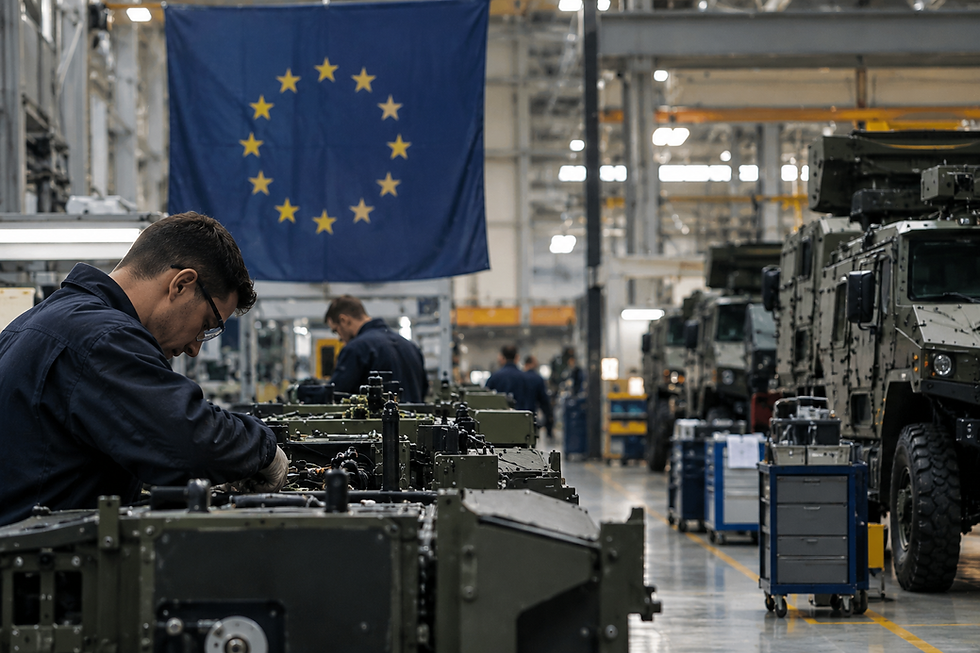
The war in Ukraine has profoundly transformed Europe’s security environment. It has served as a reminder that the defence of the continent can no longer be conceived solely within the long timeframe of capability programmes, nor through a fragmented logic. Faced with the return of high-intensity conflict and lasting geopolitical unpredictability, Europe must strengthen its capacity to anticipate, produce, protect, and respond to crises.
By Thomas Regnier, European Commission Spokesperson for tech sovereignty, defence, space and research
Accelerating the investment effort
The Commission has proposed a new financial instrument — SAFE, the Security Action for Europe — which could provide up to €150 billion in loans guaranteed by the EU budget. It is designed to enable Member States to rapidly scale up their investments in defence capabilities, particularly through joint procurement. The stakes are as much industrial as financial. Larger, better-coordinated and more predictable orders should allow Europe’s defence industry to invest, increase production capacity, and respond more swiftly to identified needs.
Investing better, together, and in a European way
Europe has a competitive defence industry, but one that remains too fragmented. The dispersal of programmes, standards and procurement limits economies of scale, drives up costs, and reduces predictability for industry. The Commission therefore encourages Member States to procure more jointly. Joint acquisitions strengthen interoperability, generate scale, and support the European industrial base. The White Paper sets clear targets: by 2030, 50% of defence procurement should come from European suppliers, with 40% carried out jointly.
This approach does not call into question Member States’ responsibility for defence. It aims to make the collective effort more coherent, more effective, and better aligned with operational needs.
Identified capability priorities
European preparedness rests on specific priorities: air and missile defence, artillery, ammunition and missiles, drones and counter-drone systems, military mobility, artificial intelligence, quantum technologies, electronic warfare, strategic enablers, and critical infrastructure. These domains address capability gaps already identified and lessons drawn from recent conflicts. They reflect a straightforward requirement: to have sufficient capabilities, adequate stockpiles, resilient supply chains, and an industrial base capable of delivering at the required speed and volume.
Supporting the scale-up of industrial capacity
Several instruments are intended to support this ramp-up. The European Defence Fund supports collaborative research and development, particularly through cross-border consortia. EDIP is meant to help reduce fragmentation and facilitate the transition from prototypes to serial production. AGILE aims to enhance the EU’s capacity to deliver defence innovation more rapidly and effectively. It will provide targeted support to a broader range of New Defence Players, including small and medium-sized enterprises (SMEs), start-ups and scale-ups to foster a more dynamic and responsive European defence innovation ecosystem.
Structuring european projects
The Commission has also identified several flagship projects, such as counter-drone capabilities, protection of the Eastern flank, the European air shield, and the European space shield. Their credibility will depend on the ability of Member States to embed them within structured capability coalitions. The roadmap thus identifies nine priority domains, including air and missile defence, military mobility, artillery systems, missiles and munitions, drones, cybersecurity, AI, electronic warfare, land combat, and the maritime domain. The aim is to move progressively from political ambition to operational capabilities, on a timeline compatible with the 2030 horizon.
Enhanced cooperation within a national framework
The debate around a possible “European army” must be approached with caution. Commissioner Andrius Kubilius’s remarks are best understood as an invitation to reflect on the EU’s capability gaps. Neither the White Paper nor the ReArm Europe / Readiness 2030 plan envisages the creation of a European army. Defence remains a national prerogative. European initiatives aim to strengthen Member States’ armed forces, improve their interoperability — notably in line with NATO standards — and support a more coordinated approach. The ambition for 2030 is therefore to build a better-prepared, more resilient Europe, more capable of responding to threats. This preparedness does not rest on a transfer of sovereignty, but on better coordination of national efforts, stronger support for industry, and more effective European cooperation.